
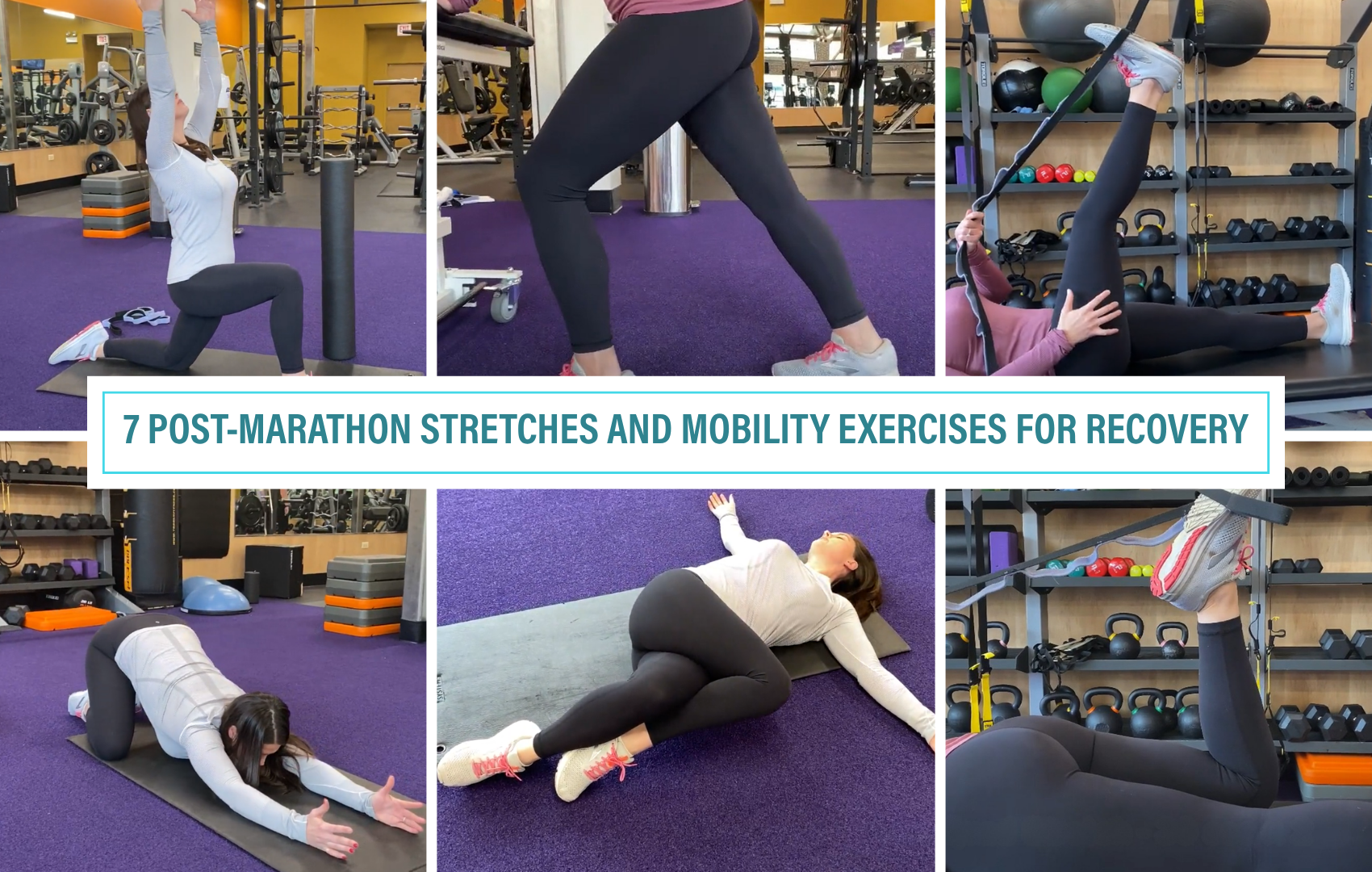
Finished a marathon? Give your body the recovery it deserves.
Crossing the finish line is a huge accomplishment, but after months of training and 26.2 miles of running, your body needs time to recover.
Gentle mobility and stretching may help you return to comfortable movement as post-race soreness settles. The key is to keep movements comfortable, avoid forcing a stretch, and give your body time before returning to intense training.
Here are seven stretches to consider adding to your post-marathon recovery routine.
1. Standing Calf Stretch
Why it helps: Running places repeated demands on your calf muscles. A gentle calf stretch can help maintain comfortable ankle movement.
How to do it:
- Stand facing a wall and place both hands against it.
- Step one foot backward, keeping the heel on the floor.
- Bend the front knee slightly while keeping the back leg straight.
- Lean forward gently until you feel a stretch in the back calf.
- Hold for 20–30 seconds per side.
2. Kneeling Hip Flexor Stretch
Why it helps: Running involves repetitive hip movement, which can leave the muscles at the front of your hips feeling tight. This stretch gently targets the hip flexors and supports comfortable hip mobility.
How to do it:
- Kneel on one knee with your other foot planted in front, keeping your front knee bent.
- Keep your torso upright and gently tuck your pelvis.
- Slowly shift your hips forward until you feel a comfortable stretch at the front of the kneeling hip.
- Hold for 20–30 seconds, then switch sides.
3. Prone Quadriceps Stretch

Why it helps: Your quadriceps help control knee movement and absorb forces during running. This stretch gently targets the muscles at the front of the thigh.
How to do it:
- Lie on your stomach with your legs extended.
- Bend one knee and bring your heel toward your glutes.
- If using a strap, loop it around your ankle and hold the ends comfortably.
- Gently guide your heel closer until you feel a stretch at the front of your thigh.
- Keep your hips relaxed and avoid arching your lower back.
- Hold for 20–30 seconds per side, as comfortable.
4. Hamstring Stretch with Strap
Why it helps: Your hamstrings help control hip and knee movement during running. A gentle strap-assisted stretch can help maintain comfortable movement as you recover.
How to do it:
- Lie on your back with both legs extended.
- Loop a stretching strap or towel around the foot of one leg.
- Slowly raise that leg while holding the strap with both hands.
- Keep your knee comfortably straight, without locking it, and gently guide your leg toward you until you feel a stretch along the back of your thigh.
- Keep your opposite leg relaxed on the floor and avoid pulling forcefully.
- Hold for 20–30 seconds per side, as comfortable.
5. Supine Twist Stretch

Why it helps: This gentle stretch encourages comfortable rotation through your trunk and lower-back area after a demanding run.
How to do it:
- Lie on your back with your knees bent and feet flat on the floor.
- Extend your arms out to the sides for support.
- Slowly lower both knees toward one side while keeping your shoulders relaxed against the floor.
- Return to the center and repeat on the opposite side.
- Move gently and avoid forcing your knees toward the floor.
- Hold for 15–20 seconds per side, as comfortable.
6. Child’s Pose

Why it helps: This gentle resting position encourages comfortable movement through your hips and back and provides an opportunity to relax after a demanding event.
How to do it:
- Begin on your hands and knees.
- Slowly sit your hips back toward your heels, as comfortable.
- Extend your arms forward and lower your torso gently.
- Breathe slowly and relax without forcing your hips or knees into position.
- Hold for 20–30 seconds, or less if needed.
7. Ankle Pumps

Why it helps: Ankle pumps encourage gentle ankle movement after the repetitive demands of running. They are a simple way to reintroduce comfortable movement during early recovery.
How to do it:
- Lie on your back or sit comfortably with your legs supported.
- Slowly point your toes away from you.
- Pull your toes back toward your shins.
- Repeat the movement smoothly without forcing your ankle through its range.
- Complete 10–15 controlled repetitions, as comfortable.
When Should You Start Stretching After a Marathon?
There is no single recovery timeline that works for every runner. In the first few days after a marathon, prioritize rest, hydration, adequate nutrition, sleep, and comfortable movement.
You do not need to complete all seven exercises immediately after the race. Introduce gentle stretching and mobility when they feel comfortable, and avoid forcing movements into sore or painful positions.
Stop if a movement causes sharp pain, increasing discomfort, or unusual symptoms. Persistent or worsening pain, significant swelling, or difficulty bearing weight should be assessed by a healthcare professional rather than treated with stretching alone.
Stretching Is Only One Part of Recovery
Stretching and mobility exercises can be part of a recovery routine, but they are not substitutes for rest, a gradual return to activity, or appropriate strength training.
As your body recovers, consider whether you experienced recurring pain, weakness, or movement limitations during training. Addressing these issues before your next training cycle can help you build a better foundation for future performance.
At PREP Performance Center, our physical therapists work with runners and athletes to address injuries, improve movement, build strength, and support a safe return to the activities they enjoy.
Ready to move better and prepare for your next goal?
Contact PREP Performance Center to learn how physical therapy can support your recovery and help you prepare for your next running goal.